


Happy Thursday, Democrats!
Today, we’re spotlighting the DNC’s Civic Engagement & Voter Protection (CEVP) Director, Herly Rosemond, a leader on the front lines of defending our democracy.
Herly and the CEVP team are building and protecting the infrastructure that ensures every eligible voter can cast a ballot and have it counted. From fighting unlawful barriers and intimidation tactics to strengthening voter education and election administration, CEVP’s work is essential to safeguarding free and fair elections.
Keep reading to learn more about Herly’s path to the DNC, the work she’s driving nationwide, and what the CEVP program is preparing for as we head toward the 2026 midterms.

Maya: Tell us about yourself, your background, and what led you to become the DNC’s Civic Engagement Voter Protection (CEVP) Director.
I am the daughter of Haitian immigrants who know firsthand the impact of poverty and lack of education. My parents know the realities of growing up in a country wherein the constitution memorialized the whims of the dictator, the self-appointed president for life. And when he changed his mind, the then-Haitian President would just pen a new constitution.
My parents never had the opportunity to vote in a democratic election in Haiti. Determined that history would not repeat itself in America, they registered to vote following their naturalization ceremony. Such was the paradigm my parents used to teach my American-born siblings and me about the fundamental right to vote and to instill in us a commitment to consistently exercise it.
I am fortunate that my parents made the connection between the United States Constitution, the Voting Rights Act of 1965, and the opportunities that eluded them in Haiti. This is my why. This is why I have spent the past 10 years in 18 different jurisdictions, often living in supporter housing, separated from my family, working on elections up and down the ballot, and curing ballots.
Collectively, these personal and professional experiences equipped me with the requisite skills to steward the national voter protection program, which safeguards voting rights and, by extension, defends the fundamental principles of democracy.
Maya: What are some of the CEVP program’s recent accomplishments?
Because this work is bigger than me and will outlive me, one week after the 2025 elections, CEVP partnered with the Training Department to host a voter protection bootcamp, where over the three-day training, we conducted more than 20 virtual training sessions led by voter protection experts, DNC staff, sister committee staffers, in-state voter protection staff, and elected officials for 459 participants to build a bench of people committed to ensuring that each eligible voter can cast a ballot and have it counted.
In response to concerns about ICE agents potentially showing up at Democratic-Farmer-Labor (DFL) caucuses in February, particularly in smaller towns with significant immigrant populations, DFL caucus site personnel were trained to serve as constitutional observers. As an added layer of support, the DNC offered a hotline, staffed remotely by CEVP volunteer attorneys, not to provide legal advice but to support caucus personnel in fulfilling their duties as trained constitutional observers.
Earlier this month, when the Boca Raton mayoral race went into a recount, CEVP partnered with the Florida Democratic Party to support Andy Thomson’s ballot cure efforts, which aimed to fix minor errors in mail-in and absentee ballots. Because we were in lockstep with the state party throughout this process, the Party was able to cure five ballots, which is the same number of votes Andy Thomson won by. This win is a testament to CEVP’s guiding principle: “every vote counts.”
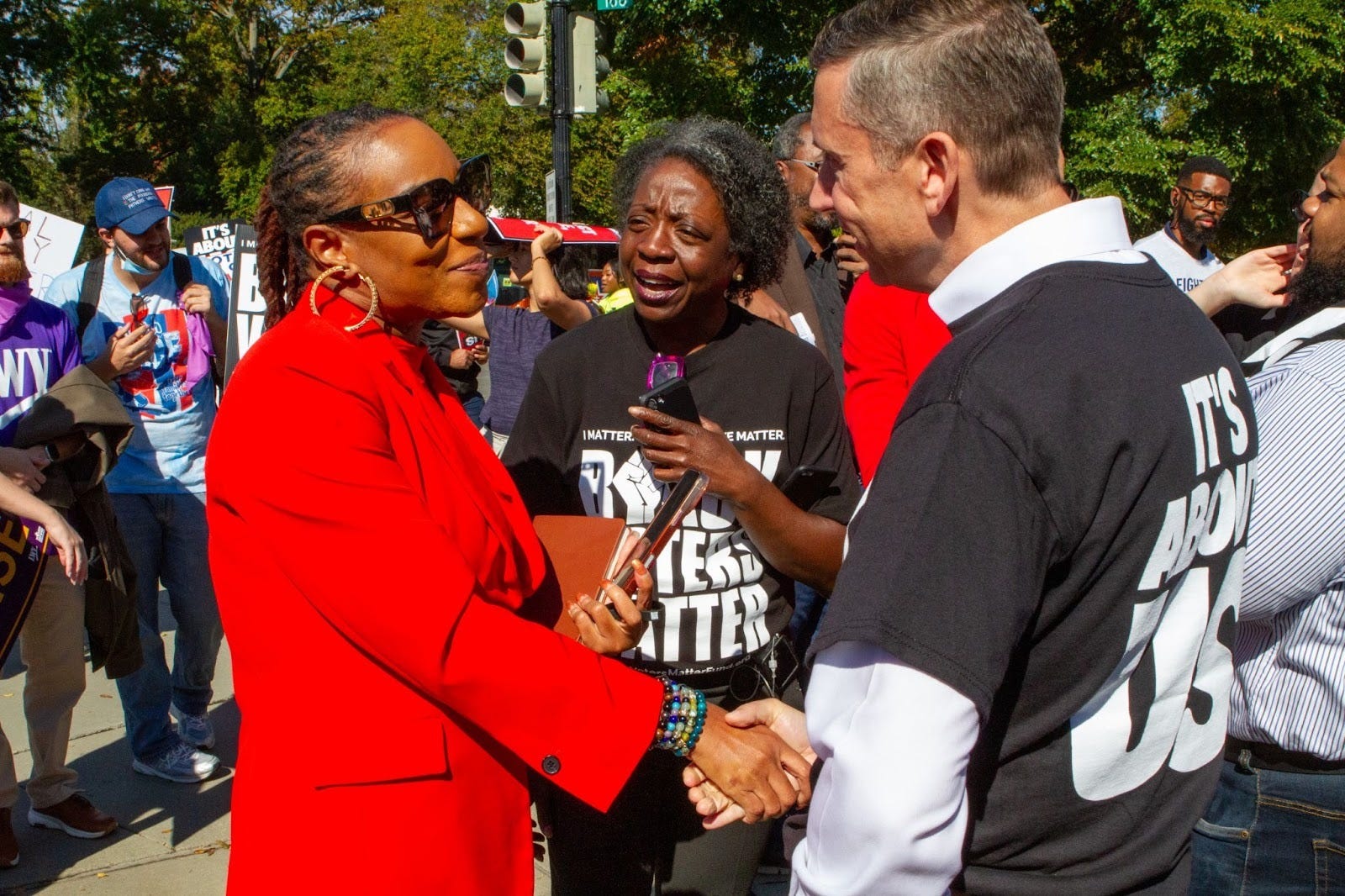
Herly attending the Fight For Fair Maps rally on October 15, 2025, as the Supreme Court heard oral arguments in Louisiana v. Callais.
Maya: What does the DNC Voter Protection team focus on?
The DNC’s CEVP program helps build and maintain the systems Democrats need so that every eligible person can register, vote, and have their vote counted without unfair barriers, threats, or confusion. We focus on stopping the main ways voters are blocked, including trouble registering, removal from voter rolls, ballot rejections, poll problems, and threats.
Strengthening Voter Protection Capacity
CEVP strengthens year-round voter protection capacity across the states and territories, particularly those that are underresourced, by providing the training, staffing support, and strategic guidance necessary to build and maintain effective voter protection programs. We build the tools and processes necessary to defend and expand access to the ballot across the country, establishing a national rapid response infrastructure to support voter protection efforts during early voting, on Election Day, and throughout the post-election period, including cure, canvas, and ballot-counting operations. And we advance long-term voting access by supporting state legislative efforts and election administration reforms that reduce barriers to participation and strengthen access for eligible voters.
CEVP works with the state parties and coordinated campaigns to build key relationships with election administrators, which are essential for quickly triaging and resolving time-sensitive voting issues during early voting and on Election Day before they become barriers to voting.
This work includes regular check-ins with local election officials, documentation of local practices regarding registration, early voting, mail ballot processing, line management, accessibility, language access, and provisional ballots. Additionally, we provide early advocacy on polling place closures, relocations, ballot-cure processes, and voter-roll maintenance.
Voter Education
We also maintain a year-round voter education and assistance program that helps voters understand how to register, maintain or update their registration, cast a ballot successfully, and what to do if they encounter a problem. This work is especially important in jurisdictions where voting rules are changing, access remains uneven, or suppression efforts are increasing confusion.
Our voter education program produces clear, practical, multilingual content covering registration requirements and deadlines, vote-by-mail rules, polling place lookup, early vote dates and hours, ID requirements, voter rights, ballot cure procedures, and provisional ballot guidance. Materials are published in digital, print, and mobile-friendly formats and distributed through state partners, field programs, canvasses, and direct voter contact. We also maintain and update voter education information on IWillVote.com, a primary destination for voter education, registration guidance, polling place lookup, deadlines, and ballot access information across all jurisdictions. Our dedicated Translation Assistance Program provides voter information, registration guidance, educational materials, digital content, and literature for in-language canvassing and direct voter outreach.
Voter Assistance
CEVP operates a national voter assistance hotline year-round, with extended hours during elections. The hotline answers voters’ questions, helps resolve problems, tracks issues such as voting barriers, and quickly handles urgent calls. In 2024, the hotline supported more than 47,000 calls in seven languages and helped over 250,000 voters through webchat and text.
We also monitor new laws and policies year-round to identify threats to voting rights or ways to make voting easier. CEVP tracks state and local rules that affect voting. We regularly update state partners, coordinate responses to new threats or reforms, and work to block tough laws and push for changes that help voters. This includes supporting laws for early voting, voting by mail, fighting intimidation, and providing language help.
And if it’s Tuesday, that means there is an election somewhere. Our day begins before the polls open. Before shifting to post-election work, we continue to support our in-state partners until we receive confirmation that all voters who are standing in line when the polls close have cast their ballots.
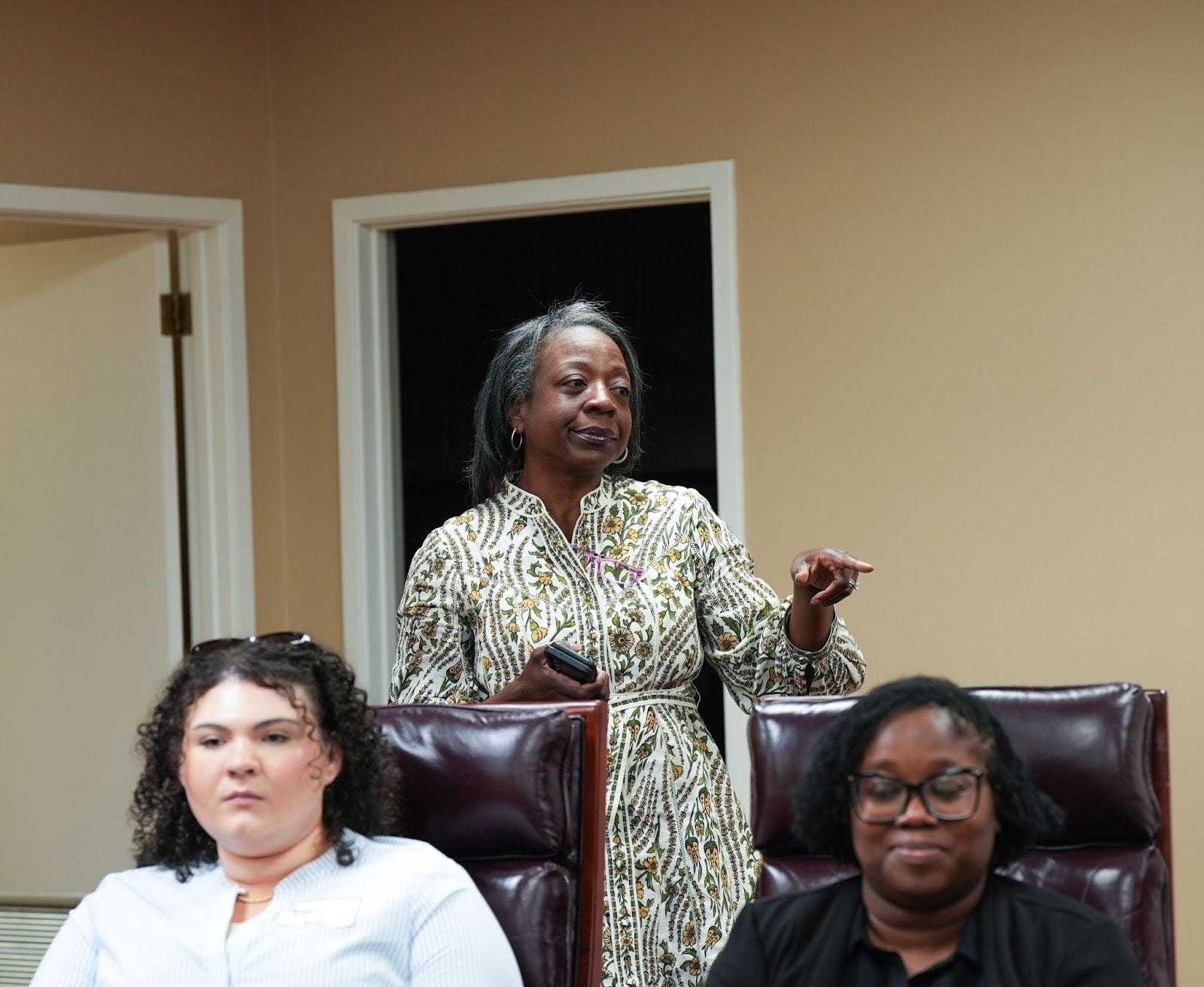
Herly speaking with volunteers from the Alabama Democratic Party and Congressman Figures’ Campaign
Maya: We’ve been hearing from grassroots supporters that they doubt the midterm elections will take place. Can you lay out the threat Donald Trump poses, and what the DNC is doing to counter his attacks?
Article I, Section 4, Clause 1 of the U.S. Constitution, the Election Clause, gives states primary authority over the times, places, and manner of federal elections. This clause does not grant any power to any president to directly control or administer state-run elections. For 239 years, the Constitution has made it clear: elections are run by the states. Period.
DNC and its state partners recruit, train, and deploy thousands of poll observers during early voting and on Election Day. Poll observers serve as the eyes and ears of the voter protection program at priority sites, allowing leadership to detect problems in real time, deter misconduct through visible presence, and quickly transmit actionable information. Priority locations are determined by a mix of factors, including history of long lines, reported issue volume from prior cycles, accessibility concerns, language-access gaps, intimidation risk, likely challenge activity, heavy turnout, prior purge activity, and demographic vulnerability to suppression. From 2021 to 2024, our poll observation operation mobilized more than 120,000 voter protection volunteers, including over 65,000 trained poll observers, and recorded more than 465,000 confirmed hours of poll observation across over 63,000 polling locations.
To address the unique threat landscape of the 2026 cycle, CEVP is working across departments to develop comprehensive counter-programming to potential GOP voter intimidation and election subversion, including concerns related to ICE, DHS, or other federal agent presence at or near polling locations, through poll observer deployment, constitutional observers, escalation protocols, and coordinated legal and operational support. These programs move beyond standard voter protection to directly counter federal overreach and strengthen election integrity. We are also working in collaboration with our sister committees to protect the election. This initiative builds the foundation for state power to block illegal federal overreach and to support local election officials under pressure.
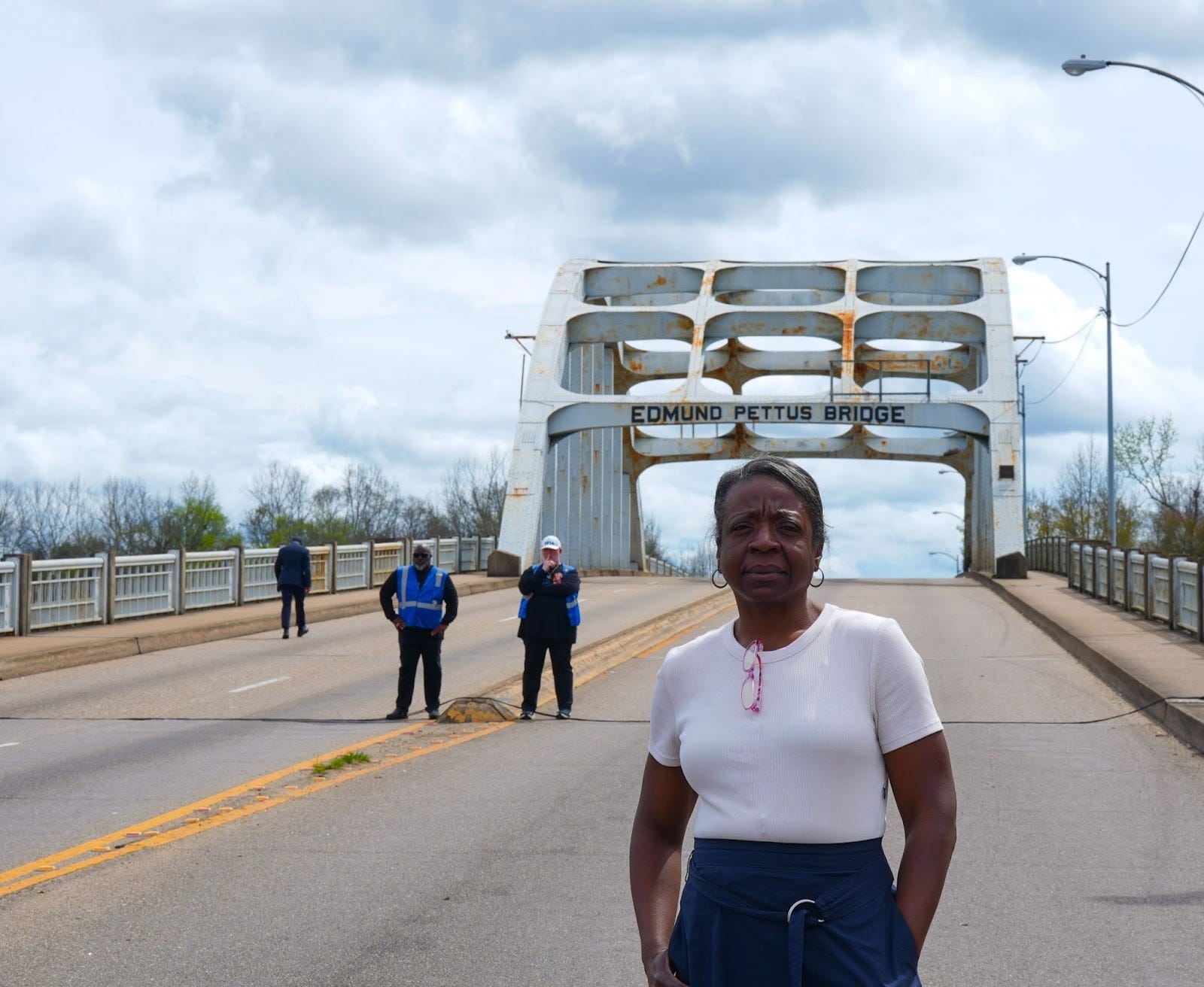
Herly in Selma, Alabama, to commemorate the 61st Anniversary of Bloody Sunday.
Maya: What actions can grassroots supporters take to fight back against Donald Trump and ensure that our elections remain free and fair?
Our democracy runs on one vital highway: the right to vote. But Republicans are closing lanes, forcing detours, adding tolls, stressing the system, and breaking the guardrails — especially in minority communities. To preserve and protect democracy, we must invest in voter protection infrastructure to keep the electoral highway running smoothly and effectively. CEVP’s staffing plan for 2026 through 2028 is designed to achieve this outcome by proactively responding to the assault on voting rights and ensuring a fair election process.
Between June 2025, when I started in this role, and January 2026, I was the only full-time staffer. With the help of supervolunteers and interns, the DNC showed up to protect over 50 elections in 2025 and execute on all the programming efforts I previously described. Protecting democracy requires financial investment. Help the DNC continue to safeguard fair and free elections by donating.
My hope, my prayer, is that you will join my colleagues and me in this fight to protect democracy. Be the reason the midterm elections are fair. Volunteer for voter protection programs across the country. Available volunteer roles include voter assistance hotline operators, poll observers, constitutional observers, count-and-canvass observers, and more!
Volunteer for voter protection programs across the country (voter assistance hotline operators, poll observers, constitutional observers, count-and-canvass observers, and more).
Share, Subscribe, and Support The Blue Print
Thank you so much for reading The Blue Print! If you enjoyed this week’s newsletter, let us know with a like, restack, and make sure to share it with your friends so we can keep bringing you weekly updates from the DNC’s Grassroots Team!
**DISCLAIMER: This article may contain outdated information or links to opportunities and other events that may have already passed. Please continue to stay updated with The Blue Print’s most recent posts for the most up-to-date information.**
Great job in explaining the important work you do!
Thank you for doing everything you do Herly!