


Whether defending our nation overseas or strengthening local communities, veterans and military families serve as pillars of America. Today, veterans and military families are leading our mission to defend our democratic institutions and our fundamental rights. This transition into civic organizing stems from a deep dedication to American values during a time when these rights face growing threats.
While Republicans remain focused on policies that prioritize billionaires and big corporations, while raising costs for Americans, Democrats are standing alongside those who served to ensure their sacrifices are honored with action, not just words. This commitment to our veterans is reflected in the work of leaders like Senator Mark Kelly (AZ) and Tammy Duckworth (IL) and in our efforts to elevate the lived experiences of those who continue to fight for our ideals, such as Vietnam War veteran William Mitchell Ellerby.
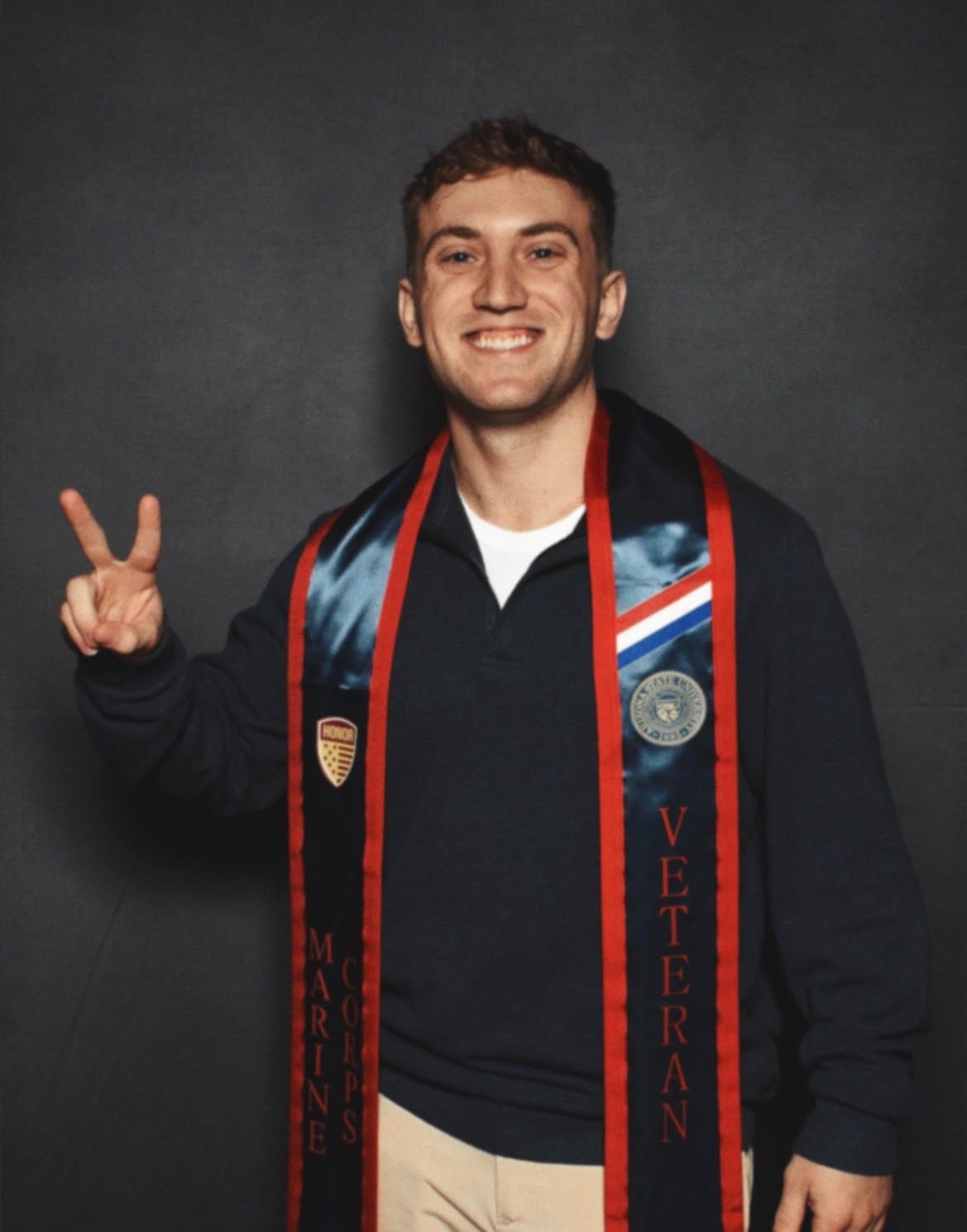
To understand the stakes of this moment, we look to the individuals leading this charge on the ground. Peter, a Marine Corps veteran, is one such voice whose journey from Marine Corps Air Station Miramar to organizing in Minnesota exemplifies this enduring ethos of responsibility. Read on for his story.
Q: Can you share a bit about your background and what led you to serve?
I am a Marine Corps veteran and a Twin Cities native, born and raised here in Minnesota. I served four years in aviation supply and logistics out of Miramar, California, and after my service, I went on to get my degree in supply chain management. I recently moved back home to the great state of Minnesota, where I now work in supply chain.
When I was young, I saw the Marine Corps as a great challenge, the path less taken, and honestly, that is why I joined. But the Marine Corps gave me something I did not expect. It gave me a completely different perspective on things than I had before. You serve alongside people from every background and every corner of this country, you carry real responsibility at a young age, and you see what people are capable of when they put the mission and each other first. You come out seeing the world and this country differently than when you went in.
And that perspective led me to the values and virtues I hold today. Liberty, democracy, equality, and the rights of every American stopped being words and became things I had seen people live out and sacrifice for. It was really after my service that those ideals became more evident to me, and they have only grown clearer as I continue to grow myself. Above all, serving in the Marine Corps gave me a strong ethos.
Q: How do you view the role and responsibility of military veterans in protecting American democratic institutions once their time in military service has ended?
When you join the military, you swear an oath to support and defend the Constitution of the United States against all enemies, foreign and domestic. You do not swear it to a President, or to a party, or to a flag. You swear it to the Constitution. Not to an identity or an ego, but to an idea. And I do not believe that oath expires when the uniform comes off, and the beard comes in.
I want to be clear that when I talk about defending democratic institutions, this goes beyond politics. Due process, equal protection, free and fair elections, a government answerable to its people. These are not partisan positions. They are the fundamental things American democracy is built on, ideals that trace back through the Enlightenment and into the American Revolution itself.
I want to be on the side of that fight that uplifted these ideas. And I believe that standing up for our democratic institutions when they are challenged is the patriotic thing to do. Patriotism is not a bumper sticker. Demanding that this country live up to its own founding ideals is not an attack on it. It is the highest thing you can do for it.
For veterans, I see this as a duty. Not because we hold some special status, but because it is a duty to your nation within the shared ideals of American democracy. We already answered that call once. The responsibility to those ideals did not end when our service did. That is why I am building a coalition here in Minnesota. Just as we once served this country in uniform, we have a responsibility to stand up and engage now. This is what serving looks like for me today.
Q: For veterans who sacrificed to uphold the U.S. Constitution, how does the Supreme Court’s approach to voting access impact you and your peers on a personal level?
Two years ago, I wrote a commentary about the Supreme Court allowing Arizona to require proof of citizenship for voter registration. I said then that the Court was siding with the powerful over the people, and that the operatives seeking to suppress the vote for political advantage were making a mockery of the Constitution I swore an oath to defend.
I wish I could say I was wrong.
This April, the Court decided Louisiana v. Callais. In a six-to-three ruling, it functionally gutted Section 2 of the Voting Rights Act, the provision that allowed voters to actually challenge discriminatory maps and voting rules, to the point that Justice Kagan wrote in her dissent that it is now “all but a dead letter.” Within days of that decision, states were calling special sessions to redraw their maps before the midterms. That is not a prediction about what might happen someday. It already happened.
On a personal level, I joined the Marines to fight for this country, its democracy, and its people. You are willing to give your life for that. So you come home, and you watch the legal protections for the most fundamental right in our democracy get stripped away, and there is no enemy to point at. There is just a decision. It is hard to serve your country when your country does not serve you.
And this goes far beyond veterans. It lands hardest on the communities that already face the most barriers at the ballot box, the same communities that fought the longest for fair representation in the first place. Every voice deserves an equal opportunity to be heard. That is not a partisan idea. That is the thing we served for.
Q: In what ways is the current political climate concerning for veterans and active military members?
There are a few things that really concern me, and I believe they are all connected to that same fight I have been talking about.
The first is what is being done to the Department of Veterans Affairs. The VA lost 40,000 employees in a single year, 88 percent of them in healthcare, which is the first net workforce loss in its history. Around 75 percent of new medical care funding is being routed to private providers while funding for the VA’s own direct care drops. And this is not abstract for us here in Minnesota. In Minneapolis, we have a five-star VA facility serving over 107,500 veterans, one of the best-performing VA facilities in the entire country, and it has already been hit. To me, this goes against something fundamental about who we are as a country. The promise made to the people who serve is one of the oldest promises America makes, and a country that stands by its ideals stands by the people who defended them. That promise is not a benefit to be trimmed. It is a debt.
The second is what happened here in my own state. This past winter, Minnesota went through Metro Surge, a large-scale federal enforcement operation in the Twin Cities. A federal judge here found that ICE violated at least 96 court orders in this state in under a month, and another federal judge said the overwhelming majority of cases brought before him involved people who were here lawfully. Our own Attorney General sued the Department of Homeland Security, and more than a dozen federal prosecutors resigned rather than go along with it. I did not need to form an opinion on any of that, because federal judges put it on the record. But what I saw on the ground was people in my community terrified, and many of them not even knowing what their rights were. Due process and equal protection are not political positions. They are the fundamental ideals this country was built on, and when the rules stop applying to the government itself, that is exactly what we swore to stand against.
And the third is the open threat of armed federal agents at polling places. Deploying troops or armed men where an election is held has been illegal in this country since 1865, and yet this administration has repeatedly declined to rule it out. I believe the threat itself is the point. Nobody has to actually show up if the possibility alone keeps people home. And there it is again, the powerful over the people, aimed directly at the ballot box. The consent of the governed only means something if the governed can vote without fear.
All of this should concern every veteran and every service member, no matter where they land politically, because none of it is about politics. It is about whether this country holds to its own founding ideals. Our oath names domestic threats specifically, and using fear to keep Americans from voting is exactly the kind of thing that language was written for. And I will say this too. No service member should ever be put in a position where following their orders and keeping their oath point in two different directions.
Q: What keeps you hopeful?
My fellow Americans.
This past winter, during Metro Surge, people in my community were targeted based on their physical appearance, based on who they are. I have friends who were pulled over because of how they looked and questioned about their immigration status. That is not an abstract concept to me. It happened to people I know, here in Minnesota.
But what I watched that winter was hate met with love, reason, and compassion. My fellow Americans did not wait for permission, and they did not wait for somebody to come lead them. They held public Know Your Rights trainings, everyday people in community rooms, teaching each other what the Constitution of the United States actually says, because that was the thing in front of us that we could do. I saw people stand up not only for the values of this country but for humanity itself, standing up for virtue in a time of fear and hate. It was a winter I will never forget.
In the dark of that winter, I saw light. And that is not new in America. There was light in the winter at Valley Forge, when a ragged army froze and starved and held on to an idea anyway. There was light in the lanterns that guided people north to freedom. There was light in the church basements of Montgomery and on the bridge at Selma, where ordinary people met hatred with discipline and love and changed this country forever. Our darkest moments have always been where Americans find out who we really are, and the light has always come from ordinary people who refused to stay home.
I have never felt so American as I did this winter, fighting for my neighbors through peaceful means, and watching the ordinary people I have known almost my whole life step up and meet the moment in greatness.
That is also why I am building this coalition here in Minnesota, because I have seen what those same ordinary people can do when they come together, and I want to give that somewhere to go.
I sign everything I write with two words. Amor Fati. It is an old Stoic idea that means love of fate. You do not get to choose the moment you live in, you only get to choose what you do with it. I did not choose this moment for our country, and I will not pretend it is not a hard one. But there is work right in front of us, and there are good people to do it with.
Amor Fati.
Your Voice is Essential
Peter’s story is just one of many veterans who are committed to serving their country by the ballot box. By sharing your story, you help shape the national narrative and drive policies that protect the benefits and healthcare services our service members have earned. Join the DNC Storytellers Network today to ensure the voices of those who served lead the way toward a future that honors their sacrifice and supports their well-being.
Make a Plan to Vote
Just how veterans serve our country and look out for their teammates, we now have a duty to ensure our communities are ready to be heard. Take five minutes today to verify your registration, then reach out to five fellow veterans, family members, or neighbors to make sure they are ready to vote as well. Our democracy relies on us to stay engaged and ensure every voice has the chance to be counted.
Share, Subscribe, and Support The Blue Print
Thank you so much for reading The Blue Print! If you enjoyed this week’s newsletter, let us know with a like, restack, and make sure to share it with your friends so we can keep bringing you weekly updates from the DNC’s Grassroots Team!
Thanks for fighting with us! Together, we can make a difference.
In solidarity,
Jenny
**DISCLAIMER: This article may contain outdated information or links to opportunities and other events that may have already passed. Please continue to stay updated with The Blue Print’s most recent posts for the most up-to-date information.**
https://substack.com/@jessicadenson/note/c-317034550?r=1eu6wk&utm_medium=ios&utm_source=notes-share-action
Profile in courage. If only more patriotic and courageous active duty service members and vets would take a stand. There is safety and power in numbers. Please share.